
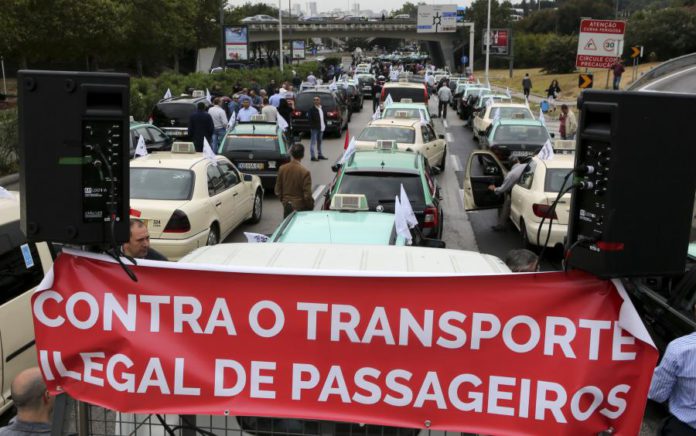
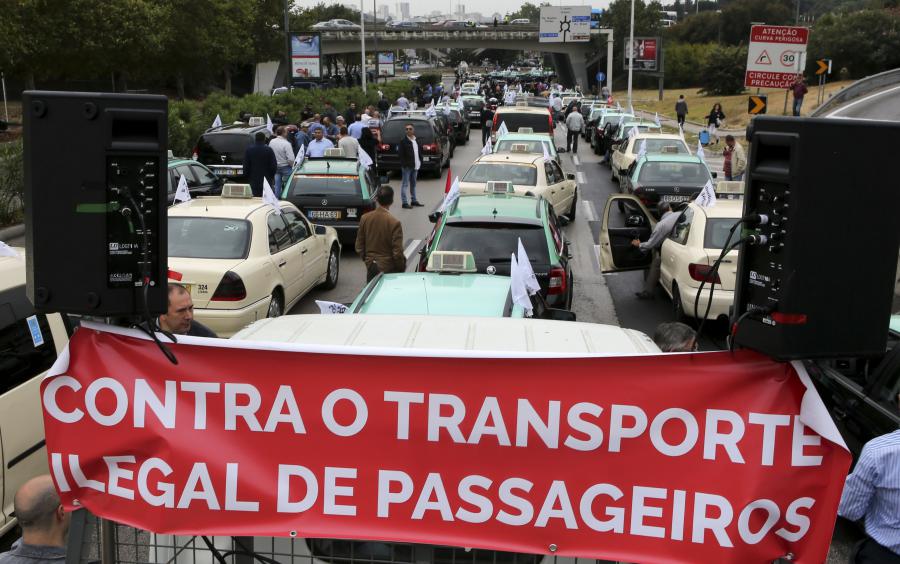
 Lisbon, Aug. 2 (Lusa) — Associations representing Portugal’s taxi drivers on Thursday announced a march to parliament and rally for 11 September, to protest against the promulgation by the country’s president of legislation to regulate online passenger transport platforms such as Uber and Cabify.
The decision was taken at a meeting between the president of ANTRAL, Florêncio Almeida, and the president of the FPT, Carlos Ramos, on Thursday morning at the former association’s Lisbon headquarters.
At a news conference after the meeting, de Almeida said that the associations would request as a matter of urgency, “if possible for tomorrow” — Friday — a meeting with Portugal’s president, Marcelo Rebelo de Sousa, in order for him to explain “personally” his reasons for promulgating the law.
The associations are demanding that the president request prior review of the legislation, to assess its constitutionality, and say that if he responds positively, the nationwide demonstration will be called off.
The ANTRAL president said that stated that the fate of the September 11th demonstration will be the Assembly of the Republic, being announced the place of initiation of the concentration, which will be revealed later.
Carlos Ramos, from FPT, added that this “day of struggle is just” given what the associations see as unfair competition from the online platforms. Between now and 11 September, joint district meetings of the two groups are to take place in Lisbon, Porto, Faro and Braga to raise awareness among the members of the protest plans.
The associations are also to formally request the Justice Ombudsman to examine whether the legislation on the platforms is constitutional.
Portugal’s head of state promulgated the legislation on Tuesday, citing in a statement published on the presidency’s website the fact that some, albeit “limited”, amendments had been made by parliament to the original bill that he had sent back to the assembly in April.
Parliament had approved the final version of the bill on 12 July, having amended it after the president vetoed the first version. The governing Socialists and the opposition Social Democratic Party and People-Animals-Nature voted in favour of the bill. With the Left Bloc, Communist Party and Greens voting against; the right-wing People’s Party was the only group to abstain.
Uber and other online passenger transport platforms had until now effectively been operating in a legal vacuum.
JGS/ARO // ARO.
Lusa